THE SACRED PILGRIMAGE

The Complete, Authentic Guide to Umrah

Welcome to an immersive, interactive study map curated in accordance with the pure Sunnah of the Prophet Muhammad ﷺ. Navigate the rituals, read certified supplications, and experience spiritual tranquility.

Virtues & Rewards

The Spiritual Dimensions of the Lesser Pilgrimage

Divine Decree (Quranic Foundation)

Completion for Allah

وَأَتِمُّوا الْحَجَّ وَالْعُمْرَةَ لِلَّهِ...

"And complete the Hajj and 'Umrah for Allah..." — Surah Al-Baqarah [2:196]

الْعُمْرَةُ إِلَى الْعُمْرَةِ كَفَّارَةٌ لِمَا بَيْنَهُمَا، وَالْحَجُّ الْمَبْرُورُ لَيْسَ لَهُ جَزَاءٌ إِلاَّ الْجَنَّةُ

Narrated Abu Hurairah (may Allah be pleased with him): Allah's Messenger (ﷺ) said: "An Umrah to another Umrah is an expiation for the sins committed between them, and the reward for an accepted Hajj is nothing but Paradise."

Reference: Sahih al-Bukhari 1773, Sahih Muslim 1349

تَابِعُوا بَيْنَ الْحَجِّ وَالْعُمْرَةِ فَإِنَّهُمَا يَنْفِيَانِ الْفَقْرَ وَالذُّنُوبَ كَمَا يَنْفِي الْكِيرُ خَبَثَ الْحَدِيدِ

Abdullah bin Mas'ud narrated that the Messenger of Allah (ﷺ) said: "Perform Hajj and Umrah consecutively; for they eliminate poverty and sins just as the bellows remove impurity from iron, gold, and silver."

Reference: Sunan an-Nasa'i 2631, Jami` at-Tirmidhi 810

Step-by-step Umrah Procedure

Detailed breakdown with authentic textual proofs from Quran and Sunnah
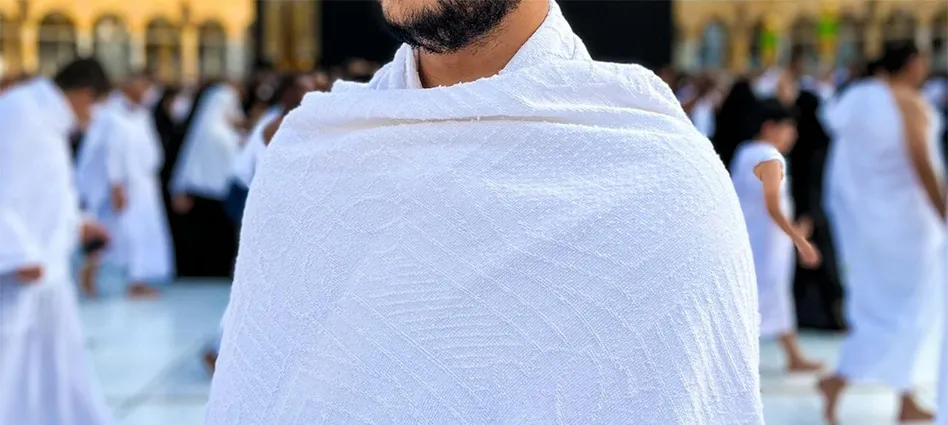
Assuming State of Ihram
STAGE 1

Ihram & Meeqat Boundary

Step 1: Assuming the Sacred State of Ihram

Before passing the assigned geographical boundaries (Meeqat) of Makkah, you must enter the state of Ihram. This process is composed of specific hygiene acts, distinctive clothing, and forming the pure intention (Niyyah) for Umrah.

1.1
Physical Purification (Ghusl): Cleanse the body completely before leaving. It is Sunnah to take a ritual bath, clip fingernails, trim the mustache, and remove underarm and pubic hair. Men may apply perfume to their hair and beard, but strictly not to the Ihram garments themselves.
1.2
Donning the Ihram Garments: Men must change into two clean, white, unstitched sheets (the Izar wrapped around the lower body, and the Rida draped over the shoulders). No underwear, socks, or headwear is allowed. Women wear simple, modest, loose clothing. Their faces and hands must remain uncovered.
1.3
Formulating the Intention (Niyyah): At the Meeqat boundary, state your sacred intention to perform the Umrah. Say the prescribed supplication aloud:
Intention Supplication (Niyyah)

لَبَّيْكَ اللَّهُمَّ بِعُمْرَةٍ

"Labbayk Allahumma bi-Umrah. (Here I am, O Allah, for an Umrah)."

Reference: Sahih al-Bukhari 1549, Sahih Muslim 1251

1.4
Continuous Talbiyah Recitation: Once in Ihram, recite the Talbiyah continuously with humbleness until arriving at the Kaaba to begin Tawaf:
The Talbiyah Call

لَبَّيْكَ اللَّهُمَّ لَبَّيْكَ، لَبَّيْكَ لَا شَرِيكَ لَكَ لَبَّيْكَ، إِنَّ الْحَمْدَ وَالنِّعْمَةَ لَكَ وَالْمُلْكَ، لَا شَرِيكَ لَكَ

"Here I am, O Allah, here I am. Here I am, You have no partner, here I am. Verily all praise and blessings, and all sovereignty belong to You. You have no partner."

Reference: Sahih al-Bukhari 1549, Sahih Muslim 1184

STAGE 2

Tawaf al-Umrah

Step 2: Tawaf (The Seven Circumambulations)

Cease reciting the Talbiyah upon entering Al-Masjid al-Haram. Walk directly to the Holy Kaaba to initiate the 7 counter-clockwise circumambulations.

Essential Tawaf Start & Corner Rules

You must align yourself completely with the corner holding the Black Stone (Al-Hajar al-Aswad) to start and finish every circuit.

2.1
Start & Gesture at Al-Hajar al-Aswad: Stand facing the Black Stone corner. At the beginning of each of your seven circuits, raise your right hand, point your palm directly toward the Black Stone, and declare the glorification below. You do not wave your hand or throw kisses from a distance.
Recited when pointing palm towards Black Stone

بِسْمِ اللَّهِ وَاللَّهُ أَكْبَرُ

"In the Name of Allah, and Allah is the Greatest."

Reference: Sahih Muslim 1218, Al-Sunan al-Kubra of Al-Bayhaqi 5/79

2.2
Circumambulation & General Dhikr: Circle the Kaaba seven times counter-clockwise, keeping your left shoulder toward it. For men, perform Idtiba' (leaving the right shoulder bare) during all seven rounds and perform Raml (jogging slightly with quick, short steps) only during the first three rounds. For the remaining four rounds, walk at normal speed.
2.3
Passing the Yemeni Corner (Rukn al-Yamani): The corner immediately preceding the Black Stone is the Yemeni Corner. When walking past, touch it with your right hand if possible (do not kiss it, and do not raise or point your hand towards it if you cannot reach).
2.4
Supplication between Yemeni Corner and Black Stone: Exactly from the moment you pass the Yemeni Corner up until you reach the Black Stone corner, you must consistently recite only this specific Quranic supplication:
Recited ONLY between Yemeni Corner & Black Stone

رَبَّنَا آتِنَا فِي الدُّنْيَا حَسَنَةً وَفِي الْآخِرَةِ حَسَنَةً وَقِنَا عَذَابَ النَّارِ

"Our Lord, give us in this world [that which is] good and in the Hereafter [that which is] good and protect us from the punishment of the Fire."

Reference: Surah Al-Baqarah [2:201], Sunan Abi Dawud 1892

2.5
Two Rak'ahs of Maqam Ibrahim: After completing the seventh circuit, cover your shoulders again, pray two Rak'ahs behind Maqam Ibrahim, and drink Zamzam water.
STAGE 3

Sa'ee (Safa & Marwa)

Step 3: Sa'ee (The 7 Trips between Safa & Marwa)

Approach Mount Safa. One-way walking from Safa to Marwa constitutes exactly one complete trip. Returning from Marwa to Safa counts as trip number two. You will complete seven trips in total, ending at Marwa.

3.1
Climbing Mount Safa and Reciting the Verse: Climb Mount Safa until you can view the Holy Kaaba. On this initial climb only, recite the Quranic foundation verse:
Recited ONLY upon climbing Safa at the very start

إِنَّ الصَّفَا وَالْمَرْوَةَ مِنْ شَعَائِرِ اللَّهِ ۖ فَمَنْ حَجَّ الْبَيْتَ أَوِ اعْتَمَرَ فَلَا جُنَاحَ عَلَيْهِ أَنْ يَطَّوَّفَ بِهِمَا ۚ وَمَنْ تَطَوَّعَ خَيْرًا فَإِنَّ اللَّهَ شَاكِرٌ عَلِيمٌ • نَبْدَأُ بِمَا بَدَأَ اللَّهُ بِهِ

"Indeed, as-Safa and al-Marwah are among the symbols of Allah. So whoever makes Hajj to the House or performs Umrah - there is no blame upon him for walking between them. And whoever volunteers good - then indeed, Allah is appreciative and Knowing. We begin with that which Allah began with."

Reference: Surah Al-Baqarah [2:158], Sahih Muslim 1218

3.2
Dua Facing the Qiblah (on Safa & Marwa peaks): At both Safa and Marwa peaks, face the Kaaba, raise your hands as in du'a, and repeat this glorification three times, making personal du'a in between:
Recited 3 times on Safa & Marwa

لَا إِلَٰهَ إِلَّا اللَّهُ وَحْدَهُ لَا شَرِيكَ لَهُ، لَهُ الْمُلْكُ وَلَهُ الْحَمْدُ، وَهُوَ عَلَىٰ كُلِّ شَيْءٍ قَدِيرٌ، لَا إِلَٰهَ إِلَّا اللَّهُ وَحْدَهُ، أَنْجَزَ وَعْدَهُ، وَنَصَرَ عَبْدَهُ، وَهَزَمَ الْأَحْزَابَ وَحْدَهُ

"There is no deity worthy of worship except Allah alone, without partner. To Him belongs sovereignty and to Him belongs praise, and He has power over all things. There is no deity worthy of worship except Allah alone. He fulfilled His promise, helped His servant, and defeated the confederates alone."

Reference: Sahih Muslim 1218

3.3
Traversing & Green Markers: Walk down from Safa towards Marwa. For men, run quickly when passing between the two sets of green neon lights. Walk normally elsewhere.
3.4
Climbing Mount Marwa: Upon reaching Mount Marwa, climb it, face the Qiblah, and repeat the same supplications as done on Safa (excluding the verse recited at the beginning).
STAGE 4

Halq or Taqsir

Step 4: Halq or Taqsir (Ending the Sacred State)

The final concluding act of your Umrah. Shaving or trimming the hair dissolves your state of Ihram, removing all spatial restrictions.

4.1
Men: Shaving (Halq) vs Trimming (Taqsir): Men are highly encouraged to shave their heads completely (Halq). Alternatively, men may trim their hair evenly across the entire head.
4.2
Women: Trimming: Women are prohibited from shaving their heads. They must gather their hair and cut exactly a fingertip's length (about 1–2 cm) from the bottom ends of their hair locks.
Prophetic Prayer for Shaving/Trimming

اللَّهُمَّ اغْفِرْ لِلْمُحَلِّقِينَ... وَالْمُقَصِّرِينَ

"O Allah, forgive those who shave their heads... and those who cut their hair short."

Reference: Sahih al-Bukhari 1727, Sahih Muslim 1301

4.3
Dissolution of Ihram: Upon shaving or cutting, all Ihram restrictions are immediately lifted. Your Umrah is now complete. May Allah accept your worship!

Pillars (Arkan) vs Obligations (Wajib)

Strict scholarly boundaries of Fiqh

It is critical from a scholarly perspective to recognize the classification of pilgrimage procedures:

3 Pillars (Rukn)

These cannot be compensated for with sacrificial offering (Dam). Omitting them renders Umrah invalid:

  • Ihram (Intention)
  • Tawaf
  • Sa'ee
2 Obligations (Wajib)

Omitting these intentionally requires offering a sheep sacrificial penalty to feed the poor in Makkah:

  • Assuming Ihram from Meeqat
  • Halq or Taqsir (Shaving/cutting)
*Source: Al-Mughni (Ibn Qudamah), Al-Majmu' (Imam al-Nawawi)